While it is getting more and more common (especially with the recent emergency remote teaching) for professors to have experience with distributed/hybrid/online education, there is still a lot of work for everyone to do before it can reach its potential (and, from there, settle into its appropriate niche). I'll use this page to highlight some resources I find especially helpful in the design, implementation, and assessment of online courses and teaching.
Models of Education
Clemson University's Office of Teaching Effectiveness and Innovation (OTEI) produced this
set of diagrams meant to give a visual (with text explanation) basis for understanding what the various "models" of distributed education look like from fully residential to fully online (with a couple of different "flipped" models in there as well).
Robert Talbert (
@RobertTalbert) provides a good number of resources on Flipped Learning over at his
blog (particularly
here).
Design
Cathy Davidson (
@CathyNDavidson) offers the prime building block for our Fall 2020 course - and through that time as:
being human. This carries across disiciplinary fields, teaching methodologies, and other things (like "content coverage") that we use as shields in our course design. Lots of important take-aways in this piece.
Robert Talbert (
@RobertTalbert) highlights the foundational importance of
hospitality as the virtue that connects teachers to students, regardless of platform or modality.
Learning
While this list concentrates mostly on the teaching side of education, we teach so that students learn. Knowing all we can know about learning - how students translate our teaching into knowledge - can challenge our teaching strategies, design choices, and virtue posture in the classroom (virtual or otherwise).
Six Strategies for Effective Distance Learning (Sumeracki, 2020) presents various ways that teachers can optimize the learning possibilities for their students. Really, anything put out by the Learning Scientists is well worth it!
Synchronous ("Live")
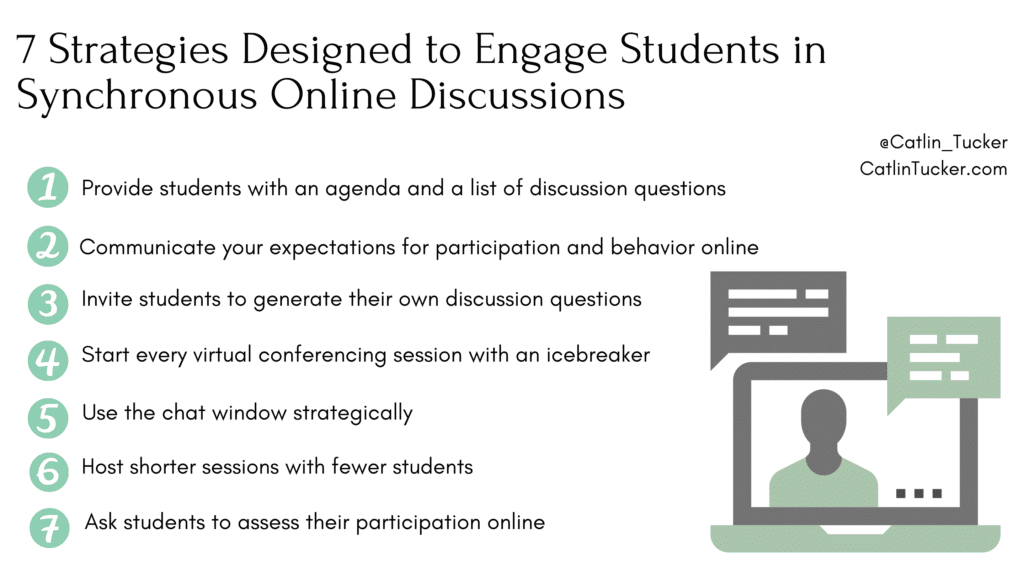
Catlin Tucker (@catlin_tucker) provides seven ideas to further engage students in live sessions past the "large group discussion format" (which, let's be honest, is really hard to do well when everyone is in person!). The infographic here gives a brief rundown, her post expands it helpfully.
Derek Bruff (@derekbruff) provides 10 strategies for the hybrid-synchronous (or fully residential, but socially distant) course. Note the emphasis on collaboration: undergrad and graduate students are junior scholars, working with the senior scholars on the furthering of knowledge and practice - this should be a fundamental assumption about the teacher-student relationship in higher ed.
Professional Development
Mini-courses from EDUCAUSE on aspects of online teaching and design
EdTechBooks provides a library of free (and not) books about various levels of Education Technology


Comments
Post a Comment